

How the Brain Reallocates Sensory Processing After Hearing Loss
When hearing, vision, touch, smell or taste changes, the brain may adapt how it uses the sensory information still available. This article explores cross-modal plasticity: activity in brain regions normally associated with one sense can change when another sense is reduced. Adaptation is not a reason to leave hearing loss unassessed.
More than two millennia ago, Aristotle described five senses working together. Later thinkers asked whether losing one sense might change the use of others. The article cites the WHO's estimate that more than 1.5 billion people worldwide experience hearing loss, making adaptation an important question.
1. From sensory-substitution ideas to neuroscience
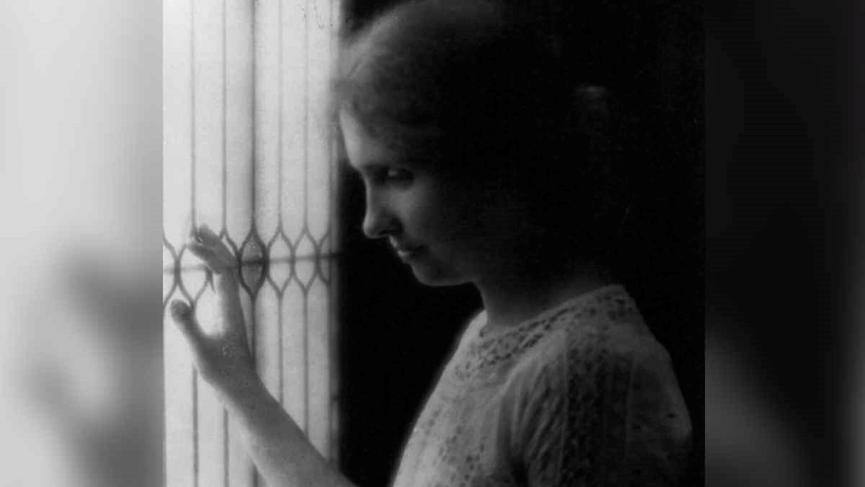
In the eighteenth century, some thinkers speculated that losing one sense might heighten another. Nineteenth-century neurologist Charles-Édouard Brown-Séquard proposed that the brain might reorganize after sensory loss. Helen Keller's experience of using touch to communicate after losing hearing and sight illustrates human adaptation, though an individual life cannot establish a general neural mechanism.
Neuroscience has since shown that sensory cortices interact rather than operating as wholly separate islands. The brain can reorganize activity in response to experience or challenge, a capacity known as plasticity.
2. Reorganization after hearing loss
The auditory cortex ordinarily processes sound. Some functional MRI studies cited by the article suggest that, after hearing loss, visual and tactile processing can recruit parts of that region. This is called cross-modal plasticity; its pattern depends on the person, timing and degree of hearing loss.
Figure caption: Two brain images compare responses to visual-motion stimuli in a person with hearing loss. The left image is described as showing visual processing recruiting an auditory region before hearing-aid use. The right is described as showing a more typical response after six months of hearing-aid use. The figure is credited to work by Hannah Glick and Anu Sharma at the University of Colorado Boulder, supplied by The Hearing Review. The image illustrates a reported observation, not proof that every wearer will show the same change.
The article suggests visual-motion awareness, lip reading and sensitivity to vibration can become more important when sound is reduced. It offers an evolutionary explanation: a person who misses an alarm or horn may rely more on other cues. These are interpretations of adaptation, not a claim that other senses fully replace hearing.
3. Vision, touch, smell and taste
Vision often becomes a key source of information. Deaf or hard-of-hearing people may use sign language, facial and body movement, lip reading and environmental cues. A cited study found faster peripheral visual responses in adults who were deaf from birth and British Sign Language interpreters than in hearing comparison participants.
Touch and vibration can also contribute. The article describes how some deaf musicians use bodily vibration to experience music and cites Beethoven as a historical example, while the exact mechanism for his continued composition is speculative. It discusses research suggesting that the inferior colliculus, a midbrain structure involved in hearing, also responds to high-frequency vibration detected by the skin.
Research on smell and taste after hearing loss is less developed. The article cites a study reporting stronger olfactory and trigeminal perception among people with congenital sensorineural deafness than among hearing controls. That finding does not mean every person with hearing loss develops a stronger sense of smell.
4. Adaptation does not replace hearing care
Hearing loss can affect communication and has been associated with depression and dementia. These associations do not establish an individual outcome. A hearing-care professional can assess a change in hearing and discuss appropriate options. The brain's capacity to adapt and the value of hearing care are both relevant.
References listed in the article
- World Health Organization. World Report on Hearing. March 3, 2021.
- Beck DL. Interview with Anu Sharma on brain changes when sound is reintroduced. The Hearing Review. 2020;27(4):10–12.
- Glick HA, Sharma A. Cortical neuroplasticity and cognitive function in early mild-to-moderate hearing loss. Frontiers in Neuroscience. 2020;14:93.
- Codina CJ, Pascalis O, Baseler HA, et al. Peripheral visual reaction times in deaf adults and British Sign Language interpreters. Frontiers in Psychology. 2017;8:50.
- Vercillo T, Scurry A, Jiang F. Early deafness and learned action–effect contingencies associated with peripheral sensory effects. Neuropsychologia. 2024;202:108964.
- Zia S. How sound and vibration converge in the brain. Harvard Medical School News & Research. December 18, 2024.
- Landry C, Nazar R, Simon M, et al. Olfactory and trigeminal perception in congenital hearing loss. European Journal of Neuroscience. 2024.
Original article: Hearing Tracker.


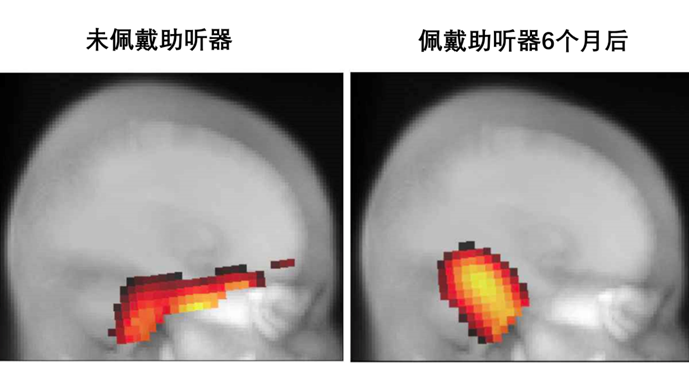
The left image is labeled “Without hearing-aid use.” The right image is labeled “After six months of hearing-aid use.”