


Mouse Study Links Chronic Stress to Changes in Auditory Processing
A mouse study at Ben-Gurion University of the Negev suggests that repeated stress can change the brain's processing of sound. Stressed mice needed louder sound to produce a response comparable to their earlier response, while responses to quieter sounds weakened. The finding concerns auditory processing in mice; it does not establish that stress causes hearing loss in humans.
Jennifer Resnik of the university's Department of Life Sciences examined how chronic stress affects neural responses to neutral sounds, an area less studied than its effects on learning or decision-making. The results were published on February 11 in PLOS Biology.
Studying the brain's response
The team focused on the brain rather than damage to the ear itself. As stress continued, responses to low-level sounds weakened markedly, while the mice still responded strongly to loud sounds. The researchers suggest altered activity among different brain-cell populations may explain the effect.
Figure caption: Two-photon imaging compared baseline and repeated-stress conditions. In the repeated-stress experiment, mice were confined in a 50 mL tube for 30 minutes, followed immediately by imaging. Individual cells were tracked across days. The figure shows imaging planes from days 1 and 9, with a 50 μm scale bar, and noise-evoked responses for three example cells as means with standard errors. Image credit: Bisharat G et al., 2025, PLOS Biology, CC BY 4.0.
Changes in cell activity
Repeated stress increased activity in a group of inhibitory neurons called SST cells, while activity in pyramidal and PV cells was reduced. Resnik said this pattern may alter how the brain responds to everyday neutral sounds. Its relevance to human sensory or mental-health conditions remains a subject for future study.
What are neutral sounds?
Neutral sounds have no obvious emotional meaning or immediate threat. Examples in the article include rustling leaves, rain, wind, air conditioning, distant traffic, simple tones and white noise. Such sounds may serve as background rather than drawing strong attention.
Original report: SciTechDaily.
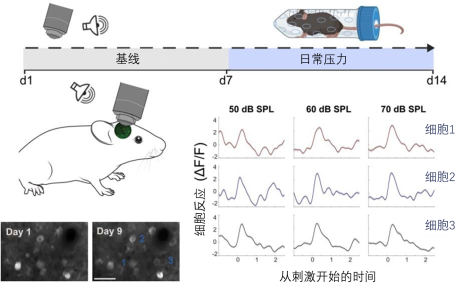
Timeline: day 1 baseline, day 7 start of daily stress, and day 14. The bottom-left images are labeled Day 1 and Day 9. The three response rows are Cell 1, Cell 2, and Cell 3; columns are 50, 60, and 70 dB SPL. The vertical axis is cellular response (ΔF/F); the horizontal axis is time since stimulus onset.
