


Chronic Stress Alters Auditory Responses in a Mouse Study
A mouse study suggests chronic stress can change how the brain responds to sound. Stressed mice needed louder sounds to produce responses comparable to those seen earlier, while their responses to quieter sounds weakened. The findings do not establish that chronic stress changes human hearing in the same way.
01. Chronic stress and sound processing
Researchers at Ben-Gurion University of the Negev in Israel investigated whether prolonged stress alters basic brain functions involved in hearing. Chronic stress is already linked with learning and decision-making difficulties, but its effect on responses to neutral sounds has been less studied. Jennifer Resnik of the university's Department of Life Sciences said the question matters because chronic stress is considered a risk factor for psychiatric and sensory disorders. The findings were published in PLOS Biology on February 11.
02. Studying the brain, not the ear
Resnik's team examined auditory processing in mice rather than direct effects on the ear. With repeated stress, neural responses to low-decibel sounds became markedly weaker over time, whereas responses to louder sounds remained strong. The researchers interpret this as a change in how the brain processes sound.
Figure: physiological and behavioral evidence of a stress response. The left panel diagrams two-photon imaging under baseline and repeated-stress conditions. In the repeated-stress experiment, each mouse was held in a 50 mL tube for 30 minutes to induce mild stress; imaging began immediately afterward. Individual cells were followed across days. The figure shows example imaging planes on days 1 and 9 (scale bar: 50 μm) and noise-evoked responses from three example cells (mean ± standard error). Image: Bisharat G et al., 2025, PLOS Biology, CC BY 4.0.
03. Cellular changes under stress
The study found increased activity in somatostatin-expressing inhibitory neurons (SST cells) after repeated stress, while activity in other cells, including pyramidal and parvalbumin-expressing (PV) cells, was suppressed. The authors propose that this shift could contribute to weaker neural responses to sound, particularly quieter sound.
04. Perception of everyday sounds
Resnik said repeated stress may alter responses not only to emotional stimuli but also to everyday neutral stimuli. That interpretation comes from mouse brain measurements; possible implications for human sensory processing and mental health require further study.
Background: neutral sounds
“Neutral sounds” are sounds without an obvious emotional meaning or immediate signal of threat. Examples in the article include rustling leaves, rain, and wind; everyday background sounds such as air conditioning or distant traffic; and simple tones or white noise, sometimes used as background sound for concentration or relaxation.
Generic image credit in the original article: online image, with no specific creator identified beyond the study-figure credit above. Original SciTechDaily report.
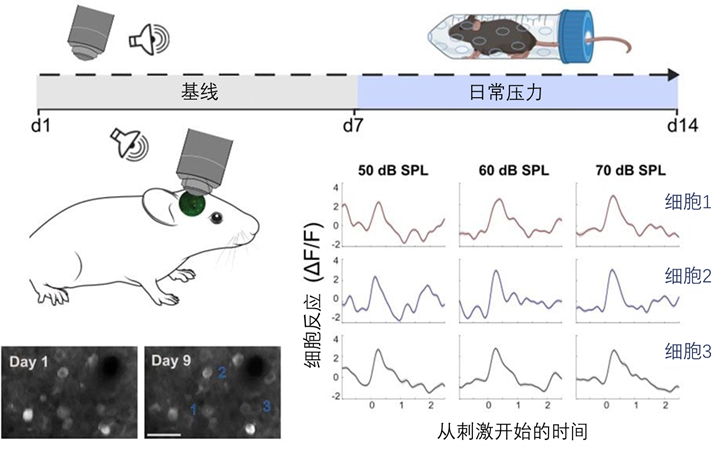
Timeline: day 1 baseline, day 7 start of daily stress, and day 14. Microscopy images are labeled Day 1 and Day 9. The response rows are Cell 1, Cell 2, and Cell 3; columns are 50, 60, and 70 dB SPL. The vertical axis is cellular response (ΔF/F), and the horizontal axis is time since stimulus onset.