


Directional Processing for Single-Microphone Hearing Aids
Authors: Niels Søgaard Jensen, MSc; Barinder Samra, MSc; Jens Hain, MSc; Eric Branda, AuD, PhD; and Jennifer Weber, AuD.
Directional processing in a single-microphone hearing aid may offer a combination of discretion and better performance in noise. The authors discuss a study of Signia's Binaural OneMic Directionality 2.0 (BOMD 2.0). They report improved speech reception while retaining the small form of completely-in-canal (CIC) aids. These are results from the stated technology and test setting, not a guarantee of benefit for every wearer.
Introduction
People with hearing loss may struggle to understand speech at social gatherings or in noisy public places. Directional microphones seek to improve speech understanding by emphasizing sound from a talker's direction while reducing background noise. Conventional two-microphone beamforming needs physical separation between microphones, which very small CIC aids cannot provide when each device has room for only one microphone.
Signia developed BOMD to link two single-microphone hearing aids into a virtual directional system. BOMD 2.0 arrived with the Signia Integrated Xperience (IX) platform and, according to the authors, is available in Silk Charge&Go IX, Insio IIC/CIC IX and Insio Charge&Go CIC IX. The article considers how the technology works across these form factors.
Binaural OneMic Directionality 2.0
A central component is Signia's e2e 4.0 low-latency, wide-bandwidth ear-to-ear link. Each aid captures sound with its microphone, and the link synchronizes and shares audio between left and right. The combined signals function as a virtual two-microphone array that can provide binaural beamforming in both ears.
Figure 1 caption: The e2e 4.0 binaural link underpins Binaural OneMic Directionality 2.0. Audio from the two microphones is synchronized, combined and processed in the left and right aids to achieve binaural beamforming.
Signal-processing algorithms compare sound level, timing and phase differences between the ears to separate desired speech from background sound. Adaptive beamforming strengthens a target talker in front while reducing unwanted sound from other directions. The ear-canal microphone position largely preserves the natural directional effect of the outer ear. The system monitors its surroundings and is described as moving smoothly between binaural beamforming and omnidirectional processing according to listening needs.
Unlike a conventional single-microphone aid with omnidirectional amplification, the authors say BOMD 2.0 can improve the signal-to-noise ratio (SNR) for speech arriving from the front. In a technical comparison of Insio Charge&Go CIC IX aids using BOMD 2.0 with single-microphone CIC aids using conventional omnidirectional processing, they report an SNR improvement of more than 7 dB. The authors equate a 7 dB improvement with a fivefold increase in the speech-to-noise intensity ratio. The behavioral study below examined whether this directional advantage translated into speech understanding.
Study: speech understanding in noise
Method
The study took place at the University of Northern Colorado and included 17 participants with sensorineural hearing loss: 10 women and seven men. Mean age was 69 years (standard deviation 13; range 25–80). Their mean four-frequency pure-tone average was 44 dB HL (standard deviation 10 dB HL; range 22–62 dB HL).
Each participant wore two Signia Silk Charge&Go IX hearing aids fitted individually with the NAL-NL2 prescription and the same Power sleeves. One test program enabled BOMD 2.0; the other disabled it and used conventional omnidirectional processing, labeled OMNI. Gain and all other feature settings were kept the same in both programs.
The researchers used a modified American English Matrix test in a sound-treated room. Target sentences came from a loudspeaker directly in front of each participant. Babble noise was delivered at 67 dBA from four other loudspeakers at azimuths of 45°, 135°, 225° and 315°. Participants repeated each sentence. Speech level adjusted automatically to identify the SNR at which 80% of words were repeated correctly, called the speech reception threshold at 80% understanding (SRT80). Test-program order was balanced across participants. The authors refer readers to a Signia white paper for further methodological detail.
Results
Figure 2 caption: Mean SRT80 under OMNI and BOMD 2.0 conditions. Error bars show the standard error of the mean; an asterisk marks a statistically significant difference (p < 0.05).
Mean SRT80 was 0.2 dB with OMNI and −1.1 dB with BOMD 2.0. Because a lower threshold indicates better performance, the mean difference favored BOMD 2.0 by 1.3 dB. A paired t-test found a statistically significant difference, t(16) = 2.47, p < .05. The authors interpret the result as better speech understanding in the tested complex-noise setting.
Discussion
The authors say the observed 1.3 dB speech-understanding difference supports the technical SNR benefit and regard it as both statistically and clinically meaningful. They propose that such a difference could help some wearers stay in a conversation that might otherwise be too difficult, but real-world benefit was not established by this sound-room experiment.
For hearing-care professionals, the authors see a way to offer directional processing in compact CIC-style single-microphone aids to people who want both speech support in noise and a discreet form factor. They argue that improved conversation in noise can complement the devices' discretion. These interpretations are made by technology-affiliated authors and should be assessed with that context.
Authors and affiliations
Niels Søgaard Jensen, MSc, is Senior Manager, Evidence and Research, at Signia in Lynge, Denmark; he is the corresponding author. Barinder Samra, MSc, is Signia's Commercial Audiology Manager in Lynge. Jens Hain, MSc, is a Principal Engineer in Signal Processing at Signia in Erlangen, Germany. Eric Branda, AuD, PhD, is Signia's Director of Hearing Technology and Research in the United States. Jennifer Weber, AuD, is Professor Emerita in the Department of Communication Sciences and Disorders at the University of Northern Colorado.
References
- Picou EM. Hearing aid benefit and satisfaction results from the MarkeTrak 2022 survey: Importance of features and hearing care professionals. Seminars in Hearing. 2022;43(4):301–316. doi:10.1055/s-0042-1758375.
- Bentler RA. Effectiveness of directional microphones and noise reduction schemes in hearing aids: A systematic review of the evidence. Journal of the American Academy of Audiology. 2005;16(7):473–484. doi:10.3766/jaaa.16.7.7.
- Jensen NS, Samra B, Hain J, Branda E. Binaural OneMic Directionality 2.0 delivers 5 times the speech enhancement in noise versus key competitors. Signia White Paper. 2025. The authors cite www.signia-library.com.
- Hörtech. International Matrix Tests: Reliable speech audiometry in noise. 2019. Report from HörTech gGmbH. The citation gives www.hz-ol-de.
Original article: The Hearing Review.



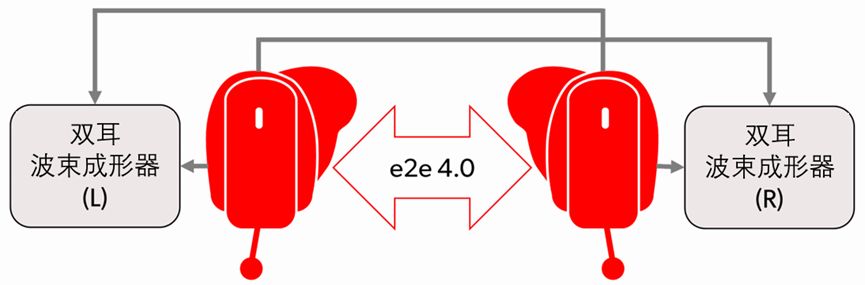
The left and right hearing aids exchange signals through the e2e 4.0 link. The Chinese labels at each end read “binaural beamformer (L)” and “binaural beamformer (R).”
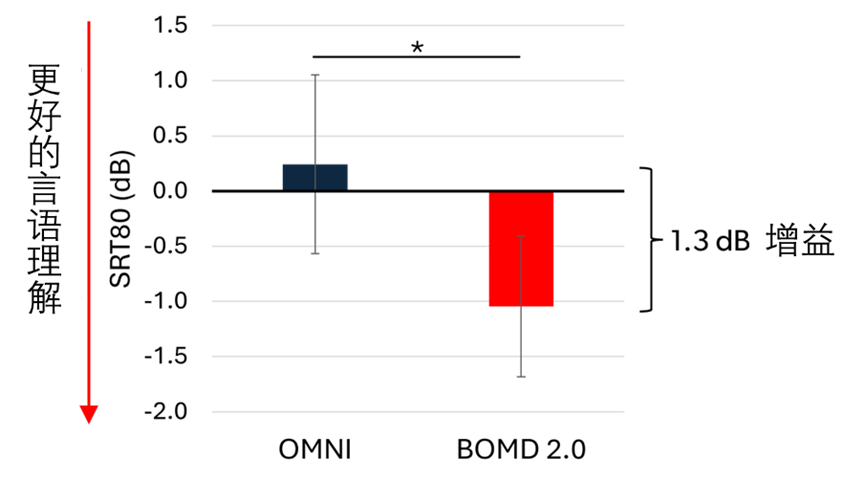
The chart's vertical axis is SRT80 (dB), marked from +1.5 to −2.0 in 0.5 dB steps; its categories are OMNI and BOMD 2.0. A bracket labels the difference 1.3 dB, with an asterisk marking significance. The Chinese side labels mean “Better speech understanding” and “Gain.” The accompanying Figure 2 caption identifies mean values with standard-error bars and p < 0.05; its text gives 0.2 dB for OMNI and −1.1 dB for BOMD 2.0 in this test.