


A Family Guide to Choosing Hearing Aids for Older Adults
Editor’s note — September 24, 2026
This historical consumer guide includes specific prevalence, dementia-risk, language-decline and purchasing figures without enough recoverable primary evidence to verify them. They should not be used to predict an individual's outcome. Hearing-aid selection, fitting and follow-up require an assessment by a qualified hearing-care professional; product instructions and current local guidance take priority over the general suggestions below.
A parent may miss repeated calls to dinner or raise the television volume because speech is hard to hear. Families often wonder whether a hearing aid would help, whether it might feel uncomfortable and whether the cost would be worthwhile. This guide sets out questions to discuss with a hearing-care professional.
Should an older person use a hearing aid?
Difficulty hearing deserves assessment rather than being dismissed as inevitable with age. The article attributes to WHO an estimate of 120 million Chinese adults over 60 with hearing difficulty and says roughly one in three people over 65 experience some loss. Those figures have not been traced to a specific WHO data table.
The article discusses research linking hearing loss with cognitive decline and claims Alzheimer's disease rates three and five times higher in older people with moderate and severe loss, respectively, than in those with normal hearing. It suggests listening effort and reduced auditory stimulation may play a part. These associations do not establish that hearing loss causes dementia or that hearing aids prevent it. Difficulty communicating may also contribute to withdrawal, loneliness, anxiety or depression, and missing horns, alarms or gas warnings can create safety concerns.
A properly selected and fitted hearing aid is intended to support listening rather than damage hearing. The article warns that a generic amplifier bought without assessment may amplify unwanted noise as well as speech. It also claims a 7% annual decline in language-processing ability with delayed intervention; that precise figure lacks a recoverable cited study here. If hearing difficulty affects daily life, professional hearing testing and discussion of suitable options are more useful than waiting or buying solely on an online listing.
How to choose an aid
The article claims more than 50 million older people in China need hearing aids and that 70% of first-time buyers choose incorrectly; it gives no source for these estimates. Its central advice is to match the device and services to a person's hearing, daily activities and ability to operate it, rather than choosing by price or feature count alone.
Three buying mistakes to avoid
- Buying before assessment: A generic online sound amplifier may lack individual adjustment. Arrange hearing testing and fitting before choosing a device.
- Prioritizing every feature: Bluetooth and phone apps may help some users but complicate use for others. Select controls that the intended wearer can operate.
- Assuming “lifetime warranty” covers everything: Ask whether microphones, chips, adjustments and replacement parts are covered and what any service costs.
Five selection considerations
- Assess hearing and ear health. The article recommends an ENT clinic or hearing center for pure-tone and middle-ear tests, identification of hearing-loss degree and type, and assessment of tinnitus or other ear problems. It gives 26–40 dB as mild and 41–90 dB as moderate-to-severe examples, then suggests more powerful devices for greater loss. Actual fitting depends on the complete audiologic assessment, not these ranges alone.
- Match features to daily settings. Noise management may matter in markets or social gatherings; Bluetooth streaming may help with television and calls. Performance depends on device and fitting.
- Keep operation and comfort manageable. Fewer controls, larger buttons or automatic volume may help people with reduced finger dexterity. Behind-the-ear devices may be easier to handle; custom in-ear or in-canal devices are less visible but need regular cleaning. The article suggests models below 5 g for comfort, though weight alone does not determine fit.
- Consider power needs. Rechargeable models may suit someone who finds battery changes difficult. The article proposes at least 24 hours of use per charge and mentions a 30-day standby option for people living alone; verify manufacturer specifications and the user's pattern of use.
- Value fitting and aftercare. Look for local adjustment and maintenance support. The article suggests a three-day trial and lists example prices: RMB 1,000–5,000 for basic, RMB 5,000–15,000 for mid-range and RMB 15,000–30,000 for higher-end models. Prices and trial terms are historical examples, not current market offers.
Getting used to an aid
The article suggests starting with one or two hours a day in a quiet home, then gradually trying busier places over one to three months. An individual's acclimatization plan should be agreed with the fitter. It advises wiping the device daily, clearing wax from the earmold or tip and storing it dry when not in use. Avoid alcohol on microphone openings; follow model-specific cleaning and drying instructions. The guide also recommends a hearing review and adjustment every six to twelve months, or sooner if hearing or device performance changes.
Families can help by encouraging assessment, supporting practice with the device and raising concerns about discomfort or poor performance with the fitting professional.
Image disclosure: The original article states that some images were AI-generated.
Should older adults wear hearing aids?
Should older adults wear hearing aids? An illustration accompanying the article's discussion of hearing care in later life.

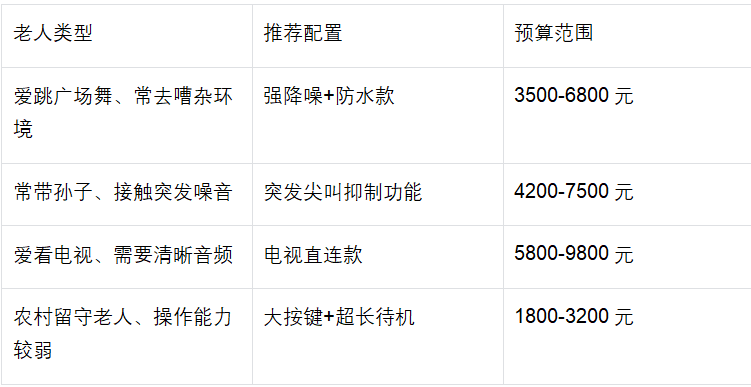
Column headings: older person's situation; suggested configuration; budget range.
Someone who dances in public squares or often visits noisy places: a strong noise-reduction and water-resistant model; ¥3,500–6,800.
Someone often caring for grandchildren or exposed to sudden noise: a sudden-scream suppression feature; ¥4,200–7,500.
Someone who watches television and wants clear audio: a direct-to-TV model; ¥5,800–9,800.
An older person living alone in a rural area who has difficulty operating devices: large buttons and extended standby time; ¥1,800–3,200.
These configurations and CNY budget ranges are examples from the dated source article, not current price quotes or individualized hearing-aid fitting advice.