


Using Noise-Cancelling Headphones More Safely
Editor’s note — September 24, 2026
This historical article gives generalized headphone-time rules and a “72-hour window” for ear symptoms without a defined diagnosis. Those are not substitutes for clinical triage. NICE tinnitus guidance calls for assessment within 24 hours when tinnitus accompanies hearing loss that developed suddenly over three days or less within the past 30 days. Seek prompt medical care for new or worrying hearing symptoms; do not wait for a generic 72-hour deadline.
An online discussion about alleged “victims of noise-cancelling headphones” included people reporting tinnitus, ear fullness, reduced hearing or increased sensitivity to everyday sounds after long use. Their accounts do not establish that active noise cancellation itself caused those symptoms.
How active noise cancellation works
Active noise-cancelling headphones use microphones to detect surrounding sound and produce an opposing signal, particularly for lower frequencies. The article argues that the cancellation function does not directly damage inner-ear hair cells or the auditory nerve. It identifies excessive sound level and duration of listening as the more important risks, whether a person uses noise-cancelling, wired in-ear or bone-conduction headphones.
Listening habits suggested by the article
- Keep the volume moderate. The article attributes a “60–60” rule to WHO: no more than 60% of a device's maximum volume for no more than 60 minutes continuously. A percentage of a volume control cannot establish actual sound exposure for every device.
- The article suggests no more than three hours of total daily use for adults, two hours for adolescents, and a five- to ten-minute quiet break after each hour. These precise times were not traced to a specific guideline and are not universal safety thresholds.
- In high-noise settings such as transit or roads, avoid turning up playback merely to mask the surroundings. Noise cancellation may help some users listen at a lower level, but environmental-awareness settings must be chosen with personal safety in mind.
- Avoid sleeping with headphones and take care not to place sustained pressure on the ear canal. Keep tips and ear pads clean, and avoid repeated or forceful ear digging; the canal normally clears itself.
- While walking, cycling or crossing streets, keep enough awareness of traffic and other warning sounds. Strong noise cancellation can make warnings harder to notice.
When to seek assessment
New or persistent ringing or buzzing, ear fullness, muffled sound, difficulty understanding speech on calls or in noise, or a noticeable hearing change warrants professional assessment. The original article urged readers to attend an ENT clinic within 72 hours, but timing depends on the symptoms and diagnosis; sudden hearing loss may require more urgent assessment as noted above.

This Weibo trending-search screenshot shows the headline “Victims of noise-cancelling headphones have appeared” at rank 2, with a displayed popularity number of 1,233,913. It is a social-media headline, not evidence that noise cancellation causes hearing loss.
Original screenshot from a Chinese social-media trending-topic page in the source article. Preserved for context; this is not a current ranking.
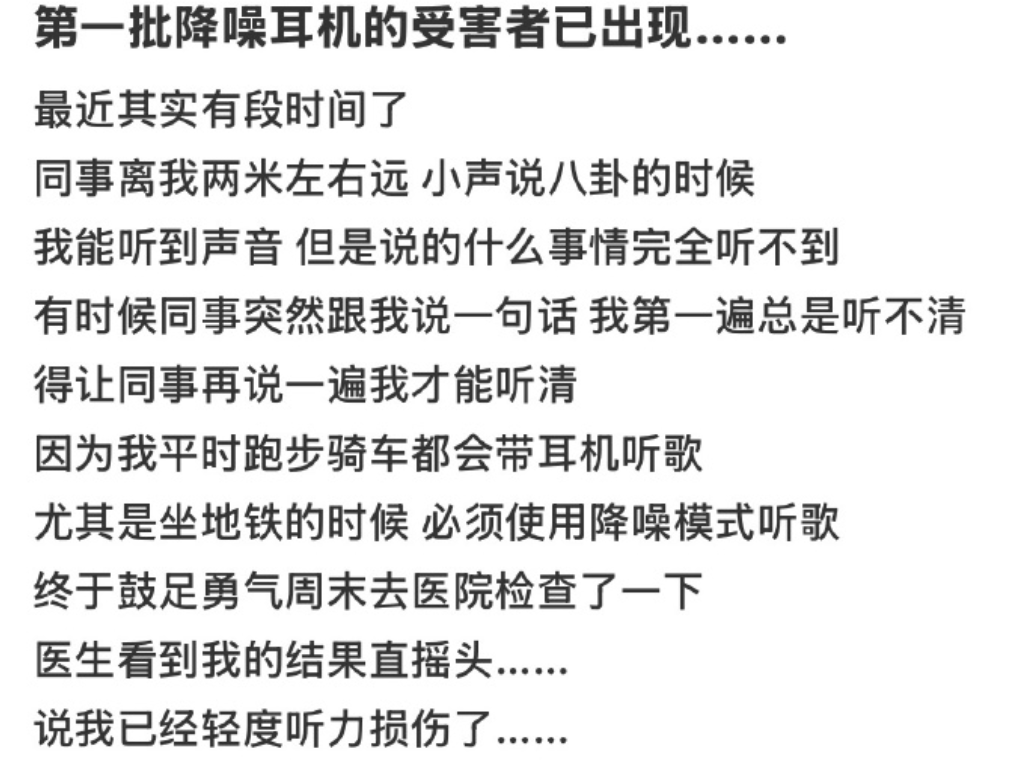
Headline in the screenshot: ‘The first victims of noise-cancelling headphones have appeared…’ This is the poster’s claim, not evidence that noise cancellation itself causes hearing loss.
‘Recently — actually, for some time now — when colleagues about two metres away talk quietly about gossip, I can hear their voices but cannot make out what they are saying. Sometimes a colleague suddenly says something to me and I cannot hear it clearly the first time. I have to ask them to repeat it before I can understand.’
‘I usually wear headphones to listen to music while running or cycling. When I take the subway, in particular, I always use noise-cancelling mode to listen to music. I finally worked up the courage to go to the hospital for a check-up at the weekend. The doctor shook their head at my results… and said I already had mild hearing damage…’
This screenshot reproduces an individual’s account; no clinical test results or independently verified diagnosis are visible in it.




An illustrated person wears over-ear headphones outdoors. The Chinese watermark says “Generated by Doubao AI.”
An illustrated person wipes headphones. The Chinese watermark says “Generated by Doubao AI.”