


Video-Game Sound Levels May Increase Hearing and Tinnitus Risk
A systematic review published in BMJ Public Health suggests video-game players may be exposed to unsafe sound levels and could face increased risk of hearing loss or tinnitus. This is a risk assessment based on the reviewed studies, not proof that every gaming session causes harm.
Researchers from the Medical University of South Carolina, the Beijing Institute of Otolaryngology and the World Health Organization analyzed 14 peer-reviewed studies involving 53,833 people. Eleven were cohort studies and three were other observational studies. Reported average sound levels ranged from 43.2 dB on mobile devices to 80–89 dB in gaming arcades, sometimes near or beyond recommended limits. Participants typically played about three hours a week.
Five of the reviewed studies examined hearing loss, hearing-threshold shifts or tinnitus in relation to gaming. Participants were mostly adolescents aged 15–20. Four studies found an association or statistically significant relationship between gaming and hearing loss or tinnitus in these adolescent and young-adult groups. The researchers also considered brief impulse sounds lasting less than a second and reported peaks as high as 119 dB.
The research team concluded that gaming is likely one source of potentially unsafe listening exposure and that many players may be at risk of permanent noise-induced hearing loss or tinnitus. The size of that risk depends on level, duration and individual exposure; the review does not establish an outcome for any one player.
Noise exposure time
The article cites 2002 guidance from the US National Institute for Occupational Safety and Health (NIOSH) and Centers for Disease Control and Prevention (CDC) on continuous time-weighted average noise. Under that occupational guideline, above 85 dB(A), each 3 dB increase halves the recommended exposure time. Readers should consider both volume and duration when playing or using headphones.
Original report: The ASHA Leader. The exposure-time graphic is credited to Dangerous Decibels.

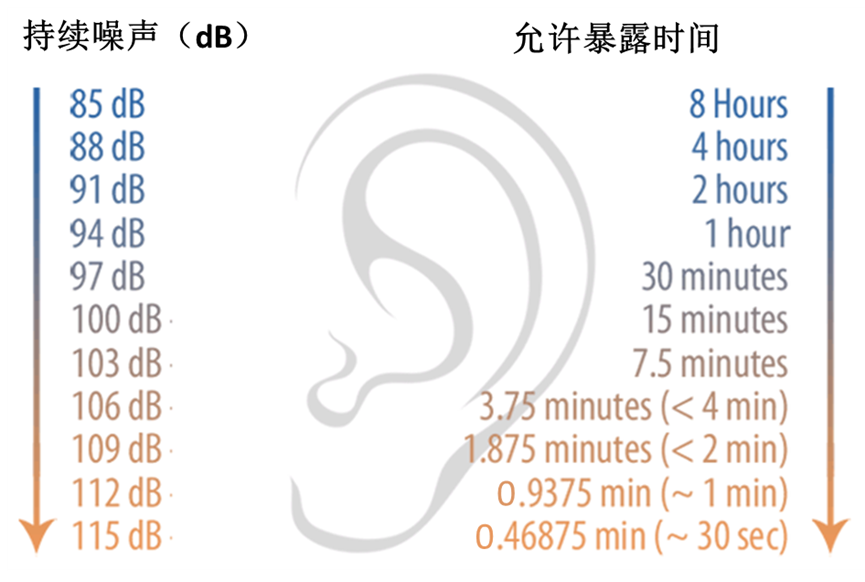
Column headings: “Continuous noise (dB)” and “Allowed exposure time.” Pairs shown: 85 dB—8 hours; 88 dB—4 hours; 91 dB—2 hours; 94 dB—1 hour; 97 dB—30 minutes; 100 dB—15 minutes; 103 dB—7.5 minutes; 106 dB—3.75 minutes (under 4 minutes); 109 dB—1.875 minutes (under 2 minutes); 112 dB—0.9375 minute (about 1 minute); 115 dB—0.46875 minute (about 30 seconds).
These exposure times are values printed in the historical source chart; they are not universal personal safety limits.